
Online Casino Game Shows in the UK: What to Know
 Available in GB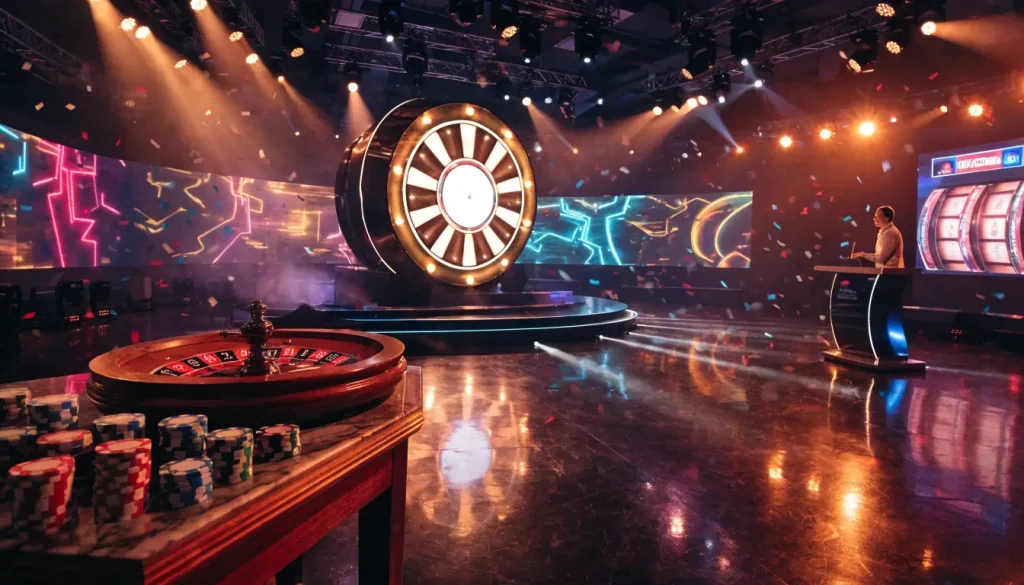
The label describes a broad style of presented casino entertainment, not a fixed set of rules or proof of how a specific game works.
The Game-Show Format in Online Casinos
A casino game show sits at an interesting border between two kinds of entertainment. It belongs to the casino because gambling is involved, but its language and presentation borrow from television: the sense of an event unfolding, a recognisable show-like frame, and an invitation to follow what happens rather than simply operate a game. The label is useful, though not exact. It describes a broad style of online casino entertainment, not a single set of rules or a guarantee that every offering bearing the name works in the same way.
That distinction matters because “game show” can sound more precise than it is. In everyday casino language, it points towards a live, presented format rather than the familiar image of a solitary player choosing a stake and setting a digital reel in motion. But the phrase does not, by itself, establish how a particular game is played, who presents it, what its rules are, or whether the experience is genuinely live in every sense a viewer might expect. The category is a signpost, not a rulebook.
The comparison with conventional online casino play helps clarify the idea. A conventional digital casino game is often encountered as a self-contained activity: its interface supplies the setting, and the player’s attention is directed towards its own rounds, outcomes or decisions. A show-style format places more emphasis on presentation. It frames the activity as something to watch as well as participate in, and its identity may depend as much on its public-facing style as on the underlying gambling element.
That is a difference of emphasis, not a clean division between unrelated products. Both formats belong to online casino entertainment; both can involve gambling; and both appear within a commercial environment shaped by operators and regulation. The game-show label does not make an activity less of a casino game. Nor does a theatrical presentation turn it into television in the ordinary sense. It remains part of a gambling service, even when the surface borrows the rhythms of a studio programme.
Online Casinos with No Limits in the UK: What It Means
A format, not a promise
The phrase “live casino game show” often carries several ideas at once. “Casino” places it in the world of gambling. “Game show” suggests an organised presentation with a recognisable entertainment frame. “Live” implies immediacy, or at least a connection to an unfolding event. Yet none of those words tells the whole story. Their combination gives a general expectation, but the actual experience depends on the individual offering.
That is why the category is best understood as a family resemblance rather than a strict technical class. One offering may foreground a presenter or a visual set; another may lean more heavily on game-like interaction. Some may feel close to a broadcast spectacle, while others may use the language of a show without resembling a television programme in much detail. The shared idea is not a particular prop, sequence or mechanism. It is the attempt to make casino play feel presented and watchable, rather than merely displayed on a screen.
The boundary is therefore cultural as well as functional. A slot may have bright graphics, dramatic sounds and a theme borrowed from popular entertainment, yet that alone does not make it a game show. It can remain a conventional game with a decorative setting. Conversely, an experience described as a game show may be distinguished by its overall presentation even if its gambling component is not immediately obvious from the label. The name points to a mode of packaging and attention; it does not settle the technical classification.
There is a familiar commercial logic behind this blend. Gambling products compete not only through their underlying rules but through the ways they invite attention. A screen can feel like a machine, a card table, a sporting event or a performance. The game-show idiom draws on a form already designed to hold an audience: something happens in sequence, a host or visual frame can give it a centre, and watching becomes part of the appeal. That resemblance need not make the casino experience equivalent to a broadcast show. It simply explains why the vocabulary travels so readily between entertainment and gambling.
A live casino game show is a broad category of entertainment that borrows television presentation styles rather than a strict set of technical rules or a specific gameplay formula.
The result is a category that can be recognised without being reduced to a checklist. There is no single visual feature that makes every case qualify, and the label cannot substitute for the rules of the particular game. A description of a game-show format should therefore avoid promising a fixed formula. The word “live” may signal a real-time presentation, but it should not be treated as proof of every detail a player might associate with live broadcasting. The show-like quality is the broad idea; the particulars belong to each individual product.
Watching and playing
Traditional casino play is often described through what the player does: selecting a game, making a wager, responding to an interface or waiting for an outcome. A show-style experience adds a second question: what is there to watch? That may shift the balance of attention. The presentation can make a round feel like a small event, with the game’s progress set within a larger visual or social frame.
This does not mean that participation becomes passive. A casino game show remains gambling entertainment, not a programme that happens to have a casino theme. The distinction is that the player may be invited to attend to the presentation as well as the gambling activity. In a conventional digital game, the interface itself may be the entire stage. In a show-like format, the interface can appear to be a window onto a performance or a shared moment.
The difference is subtle but meaningful. A player looking for a familiar solo activity may value direct control and a compact interface. Someone drawn to a show-like format may value atmosphere, presentation or the feeling that a game is unfolding in front of an audience. Those are descriptions of possible appeal, not claims that every player wants the same thing or that any format is inherently more engaging. The category reflects a different design ambition: to make the act of gambling feel staged.
Amatic Games at UK Online Casinos: What to Know
That ambition also explains why “live” can be an emotionally powerful word. It suggests presence, immediacy and the possibility of watching something happen rather than triggering a purely self-contained digital sequence. But the word should not be allowed to do more work than it can bear. A title’s label does not tell us exactly who or what is live, how the outcome is generated, or what degree of interaction is involved. Those are matters of the product’s own description and rules, not conclusions that can be drawn from the category name alone.
A further difference lies in how the experience is understood socially. Conventional online casino play can be intensely private: a person and a screen, with little sense of an audience beyond the imagined one. A show-like presentation borrows from entertainment built to be watched collectively, even when the actual casino session is individual. It can make a private activity feel more public, more performative, or more like attendance at an event. The feeling is not the same as being in a physical venue. It is an effect of presentation.
That shift is part of a broader change in digital entertainment. Online services have repeatedly turned activities once encountered alone into things that look like broadcasts, streams or performances. Gambling has its own version of this transformation. The casino screen can become a stage, though it remains a commercial gambling setting. The old distinction between audience and participant becomes less tidy. A person may be watching and playing at once. A neat boundary is elusive.
Do
- Value atmosphere and presentation
- Treat the experience as a staged event
- Recognise the role of the interface as a window
Don’t
- Expect a purely self-contained digital sequence
- Confuse a show-like format with a broadcast programme
- Assume a title’s label defines the technical interaction
The gambling setting remains
The entertainment framing does not remove the category from gambling regulation. In Great Britain, the Gambling Commission oversees commercial gambling, including remote gambling offered to consumers, and its reach does not depend on where the equipment supporting that service is physically located. The Commission is the sole regulator for commercial gambling in Great Britain. Its licensing system distinguishes between businesses that hold operating licences and individuals who require personal licences for relevant work.
That institutional structure is worth keeping in view because show-like presentation can make gambling resemble ordinary entertainment. A polished set, a presenter’s patter or a television-like visual style may soften the impression of a transaction, but the regulatory character of the activity is not changed by its staging. The format’s cultural borrowing does not place it outside the casino environment. The show is the surface; gambling remains the setting.
This is also why the category should not be confused with a promise about social safeguards, product rules or the status of a particular operator. Those questions concern the service and the specific activity, not the broad label. “Live game show” can help describe how an experience is presented, but it cannot establish who operates it or what conditions apply. A category name is not a licence.
Barcrest Online Casinos in the UK: What to Check
There is a small irony in the way the industry uses the language of entertainment. The more convincingly a gambling product resembles a familiar show, the easier it may be to overlook that it is still part of a gambling service. The point is not that entertainment presentation is deceptive by definition. It is that its cultural familiarity can blur categories which regulation has reason to keep distinct. A programme is watched; a casino game is played for a stake. A hybrid presentation can draw on the first while retaining the second.
In that sense, the game-show format is less a new species of casino than a new arrangement of attention. It makes presentation more prominent and gives the gambling activity a theatrical frame. The core distinction from conventional online casino play is not that one involves chance and the other does not, nor that one is necessarily more social or interactive. The distinction lies in how the experience is packaged: as a game encountered through an interface, or as gambling presented in the shape of an event.
Amatic Online Casinos in the UK: Games and Licensing
The phrase can therefore be useful without being definitive. It names a recognisable direction in online casino entertainment, where showmanship and gambling share the same screen. It does not supply a catalogue, a uniform set of mechanics or a guarantee about what “live” means in each case. Those details belong to individual offerings. The category itself is broader, looser and more revealing than a technical label: it shows how casinos have learned to borrow the grammar of entertainment while remaining casinos.
Top online casinos in the UK
- AmunbetBonus: Join now and get 450% up to 2,700 GBP + 450 FS · Payout speed: 1-3 business days
- ZombillionBonus: Welcome Pack 250% up to £4000 + 200 FS · Payout speed: 1-3 business days
- NightLuckBonus: Welcome Pack + 805% Up To 6400€ + 280 FS · Payout speed: 1-3 business days
- WinBeastBonus: €5000 + 500 FS + €650 Freebet · Payout speed: 1-3 business days
- x3betBonus: Welcome Pack 100% Up to £1.000 + 200 Free Spins · Payout speed: 1-3 business days
- JetsetspinsBonus: 200% Bonus + 100 Free Spins + Free Royal Wheel · Payout speed: 1-3 business days
- SpinFormulaBonus: 550% Up To £15,000 + 550 FS · Payout speed: 1-3 business days
- BritsinoBonus: Welcome Package – Get your £2,200 + 2,000 FS · Payout speed: 1-3 business days
Finding Game Shows Within a Casino Lobby
A casino lobby is a piece of organised space: a screen on which a business decides what to place near the entrance, what to group together and what to leave several steps away. Its labels may look like a neutral map of the available games. They are also editorial choices. A live game show may appear under a dedicated heading, sit within a broader live-casino area, or be easier to find through a platform’s own search and filtering tools. The arrangement depends on the operator’s interface, not on a single layout shared across the industry.
That distinction matters when the aim is to find online casinos with live game shows. The phrase describes a kind of content a platform may offer; it does not identify a common menu, a standard naming system or a guaranteed feature. One lobby may foreground categories, another may present rows of featured games, and another may place live content among a wider catalogue. A platform can change its presentation without changing what its licence means.
The lobby is not the regulator’s register. In Great Britain, a business offering remote gambling to consumers must hold the relevant UK Gambling Commission licence, even if its equipment or offices are elsewhere. The Commission regulates commercial gambling in Great Britain, while Northern Ireland falls outside the Gambling Act 2005’s territorial scope. A prominent live-games tile, a polished studio image or a familiar brand style is not evidence of a UKGC licence. Presentation and permission are different kinds of fact.
Wazdan Casinos in the UK: What to Verify
How a lobby sorts its contents
A category name is an invitation to browse, not a technical guarantee. “Live casino” may be a broad doorway, with several types of content gathered behind it. “Game shows” may be given its own place, or the phrase may appear as a filter, a search suggestion or a promotional heading. The wording is chosen for the platform’s own catalogue and interface. It should not be assumed to match the wording used elsewhere.
This is why looking for live game shows online can feel less like consulting a directory and more like learning a small local vocabulary. The same subject may be described through a short category label in one lobby and a longer promotional phrase in another. A search tool may respond to a title, a category or a partial term, depending on how that operator has built it. None of these interface choices establishes a universal convention.
Some platforms organise around broad families of games; others give prominence to selected content or recently promoted items. Those are possible design approaches, not a promise that any particular casino uses them. The useful principle is narrower: a heading tells what the operator has chosen to group together on that screen. It does not, by itself, explain the whole catalogue, the conditions of access or the regulatory status of the business.
The order of tiles can carry a quiet editorial message. Featured positions draw the eye; less prominent categories require more deliberate browsing. A lobby is therefore not simply a warehouse inventory displayed in miniature. It is a commercial interface, designed to turn a large collection into a sequence of choices. The arrangement can make a category conspicuous without making it more representative, more suitable or more reliable than another.
A search box can reduce the work of navigating that arrangement, but its result still belongs to the platform’s own catalogue system. A result may reflect the words entered, the labels attached to content or the way the operator has indexed its games. It is not an independent audit. If a result is absent, that alone does not explain whether the content is unavailable, listed under another label or simply not surfaced by that particular interface.
Attention: A category label or promotional heading in a casino lobby is a practical signpost, not a legal definition or a technical guarantee of a game’s mechanics.
Nor does a category label settle what a platform means by “live”. In ordinary lobby use, labels are practical signposts rather than legal definitions. The important point at this stage is not to infer rules or mechanics from a heading. A platform’s terms and information pages are separate parts of the service, and the category tile is only a route into its own presentation of the catalogue.
Platform choice and the UK framework
The word “casino” in an interface can make a service look like one unified product. Legally, the operator is the relevant business for the consumer relationship. Amatic Industries, for instance, holds a UK Gambling Software (Remote) licence as a supplier, not as a consumer-facing casino. It does not take deposits or bets from British players. Where its games are supplied to a UK operator, the operator holds the licence covering customer-facing matters such as deposits, payouts, bonus terms and support.
That distinction is useful beyond any one supplier. A name attached to a game or a software brand in a lobby does not tell the whole story about who provides the account, handles payments or answers a complaint. For a British player, the relevant legal question is whether the operator serving the account holds a current UKGC operating licence. The Commission’s role is not made redundant by the lobby’s own categories, nor transferred to a supplier whose name appears beside a game.
Remote gambling rules in Great Britain follow the market being served, not merely the physical location of the equipment. An operator selling remote gambling to British consumers needs the appropriate Commission licence even when its key systems are located elsewhere. In practice, that makes the operator’s identity more consequential than the apparent geography of a studio, a server or a corporate address. A screen can feel international; the regulatory obligation remains attached to serving the local market.
Betsoft Casinos in the UK: Licence Checks
A lawful online casino serving British players must operate under a current UKGC licence, and online gambling is legal for adults aged eighteen and over at such licensed sites. The UKGC also issues licences to businesses and personal licences to individuals working in specified roles. These details belong to the structure behind the lobby, not to the design of its menus. Still, they explain why a search for live game shows in the UK cannot be reduced to locating an appealing tile.
The distinction between licensed and offshore platforms is especially important when a service appears accessible from Britain. Offshore casinos operate outside the UKGC system; their visibility on the internet does not place them inside it. UK consumer protections and the operator’s regulatory duties are tied to the locally licensed framework. A page that uses British wording or displays familiar categories does not become a UK-regulated service through appearance alone.
A casino lobby may show which content the operator chooses to carry, while a regulatory register records licensing status. These are different documents serving different purposes. The first helps describe a commercial catalogue; the second establishes whether a business has authorisation to offer remote gambling to consumers in Great Britain.
What browsing can and cannot establish
A lobby can help establish that a platform presents a category or a piece of content in its own catalogue. It cannot, without further information, establish that the same category is available to every account, that the displayed selection is permanent, or that another casino uses the same label. Catalogues and interfaces are operator-specific. A visitor’s impression of a standard industry map may be only the effect of familiar design conventions.
Regulatory Status
Offshore casinos operate outside the UKGC system; visibility on the internet or the use of British wording does not make a service a UK-regulated platform.
Availability should also be kept separate from licence status. A UKGC licence authorises an operator to serve the regulated market; it is not a public endorsement of every item in its lobby. Conversely, a game-provider licence is not a substitute for the operator’s own authorisation to handle consumer gambling. The distinction is less visible than a bright tile. It is more important.
The same restraint applies to promotional language. A heading that calls something “featured” or “popular” is a platform’s presentation, not a neutral measurement of quality. The word “best” in a commercial interface may describe a selection made for that page, but it does not supply an agreed standard by which every platform can be compared. Without a common measure, the label says more about the menu than about the content.
There is a social history in these interfaces, though it is usually disguised as convenience. Casinos have long arranged games into rooms, tables and zones, making movement through a venue part of the experience. Online, the room becomes a grid and the attendant’s directions become search, filters and category labels. The old promise of effortless browsing survives in a different costume. The categories still belong to the house.
That does not make a lobby useless. It makes it specific. It can show how one operator has chosen to present its offer at a particular moment, and it can make a broad catalogue easier to navigate. It is not a market-wide directory, a regulator’s decision or a stable taxonomy shared by every casino. Treating it as any of those things gives an interface more authority than it has earned.
For a UK audience, the sensible order of interpretation is therefore structural rather than promotional: identify the operator behind the account, distinguish that business from any software supplier, and understand that UKGC authorisation belongs to the operator serving the market. Only then does a lobby’s organisation become useful as a description of what that platform presents. A category label can point. It cannot certify.
The search for live game shows across online casinos is ultimately a search across separate commercial interfaces, each with its own arrangement and vocabulary. The relevant platform may make a category easy to spot or fold it into a wider section; either way, the menu remains the operator’s map, not the territory of UK regulation. A modest map.
BGaming Casinos in the UK: What Can Be Verified
Named Show Formats and the Limits of What Can Be Verified
A branded name can make a casino search feel more precise than the information behind it. A phrase may point towards a particular show format, but the words alone do not establish which game is being offered, who supplies it, or whether it is available to customers in Great Britain. Those are separate claims, and each needs its own evidence.
That distinction matters when a name circulates as shorthand. People may use it to refer to a style of televised-looking casino entertainment, to a particular product, or simply to the kind of experience they hope to find. The meanings can overlap in ordinary conversation. They should not be treated as interchangeable in a factual description.
A branded label is not a licence record. Nor does it establish that an operator currently carries the corresponding title. A casino may describe a section using familiar promotional language, while the actual game catalogue and provider information sit elsewhere. Even a name that appears in an operator’s materials says only what those materials support: it does not, by itself, confirm every detail that might be attached to the name elsewhere.
This is where claims about individual shows require restraint. A title-specific account might describe its rules, rounds, presenters, prizes, or technical features. Without reliable evidence for those particulars, repeating them would turn recognition into assertion. The same caution applies to claims about availability, launch dates, or a game’s relationship to another branded format. Familiarity is not verification.
The British regulatory setting provides one firm point of reference, though not a shortcut to a catalogue. Remote gambling offered to consumers in Great Britain is regulated by the UK Gambling Commission, and a business offering real-money gambling to those customers must hold the relevant UKGC licence. The Commission’s role concerns the operator and the regulated activity; a product name in promotional copy is not a substitute for checking the status of the business offering it.
Amatic Slots at UK Online Casinos: What to Know
The distinction between a supplier and an operator also matters. A supplier’s presence in the industry does not mean that it runs a casino or accepts customer deposits. The operator is the party responsible for the customer-facing gambling service. That basic separation can be obscured when a branded title becomes the main object of attention. A memorable name travels more easily than the corporate structure behind it.
Names also encourage false certainty because they appear stable while catalogues are not. An operator’s available games can change, and a title may be absent from one service while appearing on another. A description written as though availability were permanent can become misleading without the name itself changing. A brand is not a live inventory.
Nor does a similar-sounding label prove that two products share a developer, format, or set of rules. Branding can suggest a family resemblance; it cannot confirm one. Establishing a connection requires information about the products themselves, not an inference drawn from their names. The distinction is small on a page and substantial in practice.
For that reason, branded terms are safest treated as identifiers whose meaning must be established in context. A factual account can say that a name is being used to refer to a show or game only where that connection is supported. It should not fill gaps with imagined mechanics or borrow details from another title because the names seem related. The temptation is obvious. So is the risk.
The resulting description may be less vivid than a confident catalogue entry, but it is more useful than one built on assumptions. Where the available information supports only a distinction between a branded phrase and a verified product detail, that distinction should remain visible. A name may guide attention; it cannot do the work of evidence.
What the Term “Live Casino Game Show” Covers
“Live casino game show” is a category label, not a precise description of a game’s rules. It joins two ideas: a connection with the live-casino part of an online casino, and a presentation described in the language of television game shows. The phrase helps distinguish a kind of casino entertainment in broad terms. It does not, by itself, establish what happens during play.
Category Definition
The term "live casino game show" describes a presentation style that combines live-casino elements with television-like framing, but it does not define the specific rules or providers of an individual game.
That distinction matters because familiar words can sound more exact than they are. “Live” may suggest immediacy and a shared event; “game show” carries associations with spectacle, contests and entertainment designed for an audience. In a casino setting, those associations help people recognise a format. They are not a substitute for a particular game’s description.
The label is therefore best understood as a piece of classification. It places an offering alongside live-casino entertainment while signalling a game-show identity. It does not reveal whether a particular title is available, who provides it, or what its conditions are. Nor does the phrase alone establish how participation works. Those details belong to the individual offering, not to the category name.
There is a small cultural history embedded in the wording. The television game show made play into a public performance: rules, suspense and prizes became material for spectators as well as participants. Casino language borrows that vocabulary because it is immediately legible. It promises a recognisable style of entertainment, not necessarily a faithful replica of a broadcast programme. The borrowing is convenient. It is also imprecise.
In ordinary casino terminology, “live casino” and “game show” do different jobs. The first places something within a broad area of casino entertainment; the second supplies a description of its presentation. Put together, they create a useful umbrella term, but not a technical specification. Two offerings carrying similar labels need not share the same design, rules or experience. A common category does not make them interchangeable.
The same caution applies to the phrase “live game show casino”. Read naturally, it points towards a casino offering game-show-style entertainment associated with live casino play. It does not mean that the casino itself is a television game show, or that every title in its live-casino area belongs to this category. The words describe an area of entertainment, not the whole platform.
New online casinos in the UK: what Amatic means
This is where category language can be mistaken for a promise. A title or menu label may evoke a familiar kind of show, but the evocation cannot settle practical questions. The game’s own information is what defines its terms. A label cannot tell whether an offering is available in a particular account, explain its rules, or establish which operator is responsible for it. Names are signposts, not contracts.
The word “live” also deserves restraint. In everyday use, it suggests something happening in real time rather than a wholly pre-recorded presentation. But the category phrase alone should not be stretched into claims about a specific production, presenter, studio, schedule or method of interaction. Those are concrete properties, and they cannot be inferred reliably from a broad label. The distinction is less thrilling than the label. It is more useful.
Likewise, “game show” should not be treated as proof of a particular contest structure or a familiar television mechanic. The term can describe a style or framing without specifying how a game proceeds. A casino category can borrow the atmosphere of popular entertainment while remaining its own kind of product. The resemblance may be in presentation; the name alone cannot say more.
For UK players, the phrase also does not identify who is offering the game. A casino operator and a game supplier have different roles: the operator provides the consumer-facing gambling service, while a supplier may provide software. A category label does not name either party, and it should not be read as evidence of a particular licence or regulatory status. The vocabulary sorts entertainment; it does not settle responsibility.
The most dependable reading is therefore modest. A live-casino game show is an offering grouped under a broad casino label that combines live-casino association with game-show-style presentation. Beyond that, the meaning depends on the individual title and the information attached to it. The term can orient the conversation, but it cannot carry every detail a player might want to know.
That is the boundary of the phrase: a useful description, not a complete definition. Its meaning lies in the category it suggests, while the particulars remain particulars.
What is the new UK slots stake limit, and how does it affect Amatic games?
The limit is £5 per game cycle for players aged 25 and over, and £2 for those aged 18 to 24. It applies to online slots, including Amatic games, at UK-licensed operators.
Are Amatic slots covered by GamStop self-exclusion?
Yes. GamStop is mandatory at all Great Britain-licensed online operators, so self-exclusion applies to Amatic slots offered by those operators.
What is the RTP of Book of Aztec and other top Amatic slots?
Book of Aztec is available with RTP versions of 90.57% and 97.63%; the version offered can vary by casino.
What is Amatic Industries, and when was it founded?
Amatic Industries GmbH is an Austrian business-to-business gaming software supplier, founded in 1993. It does not operate casinos for consumers.
Do Amatic slots come with their own welcome bonus or free spins?
Bonuses are offered by the casino operators, not by Amatic. 32Red, Betfred and Bet365 offer free-spin wins with no wagering requirement; Bet365’s offer requires a £10 minimum lifetime deposit and distributes up to 500 spins over 10 days.
Can I deposit with cryptocurrency at a site offering Amatic slots?
No UKGC-licensed operator was confirmed as accepting cryptocurrency for Amatic play. Offshore casinos offering these games operate outside the UK regulatory framework.