
Live Casino Lightning Roulette in the UK: What to Know
 Available in GB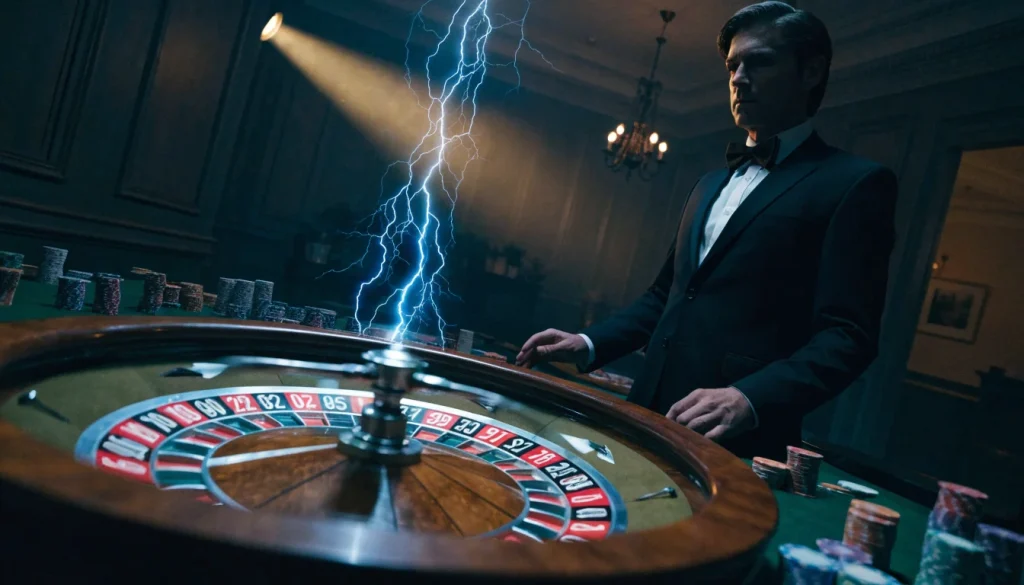
Lightning Roulette pairs a live-dealer setting with multipliers, while casino checks, demo play and player protections shape the wider experience.
Lightning Roulette in the Live Casino
Lightning Roulette belongs to the live-casino branch of online play: roulette presented through a live table rather than as a purely computer-generated game. The distinction is more than scenery. A wheel, a dealer and the visible progress of a round give the game a physical setting, even when the table is watched on a screen. The familiar roulette layout remains the point of reference; the live format supplies its human pace and the sense that events are unfolding in a shared room.
The name also signals a variation on standard roulette. Lightning Roulette combines the roulette format with a feature that can assign multipliers to selected numbers. That changes the character of the round without replacing its central ritual: wagers are placed on the layout, the wheel turns, and the ball settles on a result. The added feature gives the game its own identity, but it does not make the wheel predictable. A dramatic screen effect is still an effect, not a clue about what will land next.
Live Dream Catcher Casino in the UK: What to Check
That difference matters because live casino games occupy an unusual space between an old public institution and a private digital activity. Roulette was built around a visible object and a moment of suspense that everyone at the table could follow. Online, the same basic spectacle is carried into a room at home. The camera makes the wheel present; the interface makes the betting layout usable. Neither removes the distance between the viewer and the table. It simply gives that distance a polished frame.
Lightning Roulette is therefore not best understood as a video of roulette with a decorative title attached. Its live presentation and its special feature work together to create a distinct version of the game. The dealer’s actions provide a human sequence to watch, while the feature adds an extra layer of anticipation around the result. The underlying chance remains central. That is the quieter fact beneath the bright production.
The live format can also make the rules feel less abstract. A physical wheel turning is easier to read as an event than a sequence of animations, and the dealer’s presence places the game within a recognisable casino tradition. Yet the screen is not a guarantee of greater control or insight. Seeing a process take place is not the same as being able to influence it. The table is visible; the outcome remains uncertain.
Best High-RTP Slots in the UK: How RTP Works
This is part of the appeal of a live roulette game: it offers a ceremony as well as a wager. There is a beginning, a pause, a visible result. The dealer keeps that sequence legible, while the interface translates the table into online play. Lightning Roulette layers its own variation onto that structure, so the experience is both recognisable and deliberately heightened. The spectacle can be lively. The mathematics does not become sentimental.
In Britain, live casino play did not arrive as an entirely unfamiliar idea. Grosvenor introduced live casino games in 2013, with roulette among a range that also included blackjack and Texas Hold’em. That detail places the format within an existing casino tradition rather than treating it as a novelty invented by streaming technology. Online presentation changed where the table could be watched; it did not erase the older social meaning of a dealer-led game.
For anyone encountering the title, the essential frame is simple: Lightning Roulette is roulette in a live-casino setting, with an added feature that distinguishes it from a standard table. The live dealer gives the round a human rhythm; the wheel supplies the uncertainty. The screen joins the two, without turning chance into a promise.
Top online casinos in the UK
- AmunbetBonus: Join now and get 450% up to 2,700 GBP + 450 FS · Payout speed: 1-3 business days
- ZombillionBonus: Welcome Pack 250% up to £4000 + 200 FS · Payout speed: 1-3 business days
- NightLuckBonus: Welcome Pack + 805% Up To 6400€ + 280 FS · Payout speed: 1-3 business days
- WinBeastBonus: €5000 + 500 FS + €650 Freebet · Payout speed: 1-3 business days
- x3betBonus: Welcome Pack 100% Up to £1.000 + 200 Free Spins · Payout speed: 1-3 business days
- JetsetspinsBonus: 200% Bonus + 100 Free Spins + Free Royal Wheel · Payout speed: 1-3 business days
- SpinFormulaBonus: 550% Up To £15,000 + 550 FS · Payout speed: 1-3 business days
- BritsinoBonus: Welcome Package – Get your £2,200 + 2,000 FS · Payout speed: 1-3 business days
Where Online Casinos Fit into the Search
A request for online casinos offering Lightning Roulette is not quite a request about roulette. It is a request about access: which gambling sites present the game, whether it appears in their live-casino catalogue, and whether a result is relevant to someone looking in Britain. The distinction matters. A page about the game can explain what it is; it cannot, by itself, establish where it is available.
The phrase “Lightning Roulette casinos” compresses several separate questions into a handful of words. “Online” rules out a visit to a physical casino. “UK” narrows the intended market. “With Lightning Roulette” asks about a particular title rather than live casino games in general. Search results may treat these as one request, but a reader arriving at them is often trying to find a usable route from a named game to a place that offers it.
A result can be relevant in subject but not in practice; the presence of a game name in a heading is not proof that the game is currently available.
That route is less orderly than the wording suggests. A casino’s catalogue may change, a page may describe a game without linking to a playable version, and a third-party article may repeat an old availability claim. A result can therefore be relevant in subject but not in practice. The name in a heading is not proof that the game is currently present; equally, a broad page about live roulette may omit the title even where it is offered.
There is also a difference between searching for a casino and searching for a list of casinos. The first can lead to an operator’s own site, a review page or a general directory. The second implies that someone has gathered and checked several options. A page that uses list-like language without saying how its entries were established can make a collection look more authoritative than it is. Neat formatting is not verification.
The word “best” adds another layer. It can mean a preference for a particular interface, a live-game catalogue, or the general terms of an account. Those are not interchangeable measures, and a result that ranks casinos may be answering a different question from the one its headline appears to promise. The label is easy to publish; the basis for it is harder to see. That is the part worth noticing.
A search focused on the UK also carries a local meaning beyond geography. Online gambling offered to people in Great Britain sits within a domestic licensing system, rather than becoming a British service simply because a site is accessible from a British screen. Search placement, British spelling or a flag in an advert cannot settle that distinction. The online market has borders, even when the pages do not.
Online American Roulette Casinos in the UK: What to Know
One dated example shows why claims should be read in context. A specialist review reported that the public Gambling Commission register dated 26 September 2026 did not identify a LuckyPays entry under that brand or its stated domain, including luckypays.io. That is a report about what the register showed on a particular date, not a timeless directory entry or a general statement about every casino carrying the game. The difference between a dated observation and a current status claim is not pedantry. It is the difference between a record and an assumption.
Search results are also shaped by what publishers choose to call a page. “Live casino” may refer to a broad category; a page naming Lightning Roulette may be a single-game description; a casino review may mention the title only in passing. These pages can appear side by side because they share words, not because they offer the same evidence. Their usefulness depends on what they actually establish.
So the casino-focused search is best understood as a request for a connection between three things: a named game, an online operator, and the British market. A result may address only one or two. The rest has to be read from the page itself, rather than inferred from its headline. A search engine can assemble the trail. It cannot make every link in it equally dependable.
Online gambling offered to people in Great Britain must sit within a domestic licensing system, regardless of whether a site is accessible from a British screen.
An Online Casino with Lightning Roulette: Availability and Checks
Finding Lightning Roulette on a casino’s games page answers only one question: whether that site appears to offer the game. It does not establish that the business is authorised to take real-money wagers from people in Great Britain. Those are separate checks, and treating them as one is an easy way to mistake a polished catalogue for evidence of a legitimate operator.
The distinction matters because an online casino is not simply a collection of games. It is a business taking deposits and accepting wagers under rules that apply to the market it serves. The UK Gambling Commission oversees gambling in the United Kingdom, including online casino activity. For remote operators serving consumers in Great Britain, the Commission requires the appropriate licence. A game title on a website cannot substitute for that authorisation.
Check the operator, not just the game
A search for an online casino with Lightning Roulette may lead to a page naming the game, a promotional banner or a general casino lobby. Each can be useful for confirming that the title is advertised, but none proves that the operator holding the account is licensed. The relevant question is not merely whether Lightning Roulette appears on screen; it is whether the company offering the account is authorised to provide remote gambling in Great Britain.
Before depositing, the licence number should be checked against the UK Gambling Commission’s public register. The name attached to the account, the company named in the site’s terms and the licensed business should make sense together. A familiar brand can have more than one corporate entity behind it; conversely, a company name buried in legal text may not be the name displayed across the site. The check is about identifying the business responsible for the gambling service, not recognising a logo.
European Roulette Online in the UK: Wheel and Bets
A licence number printed in a footer is a claim, not its own proof. The register is the independent point of reference. If the number cannot be found there, or the listed business does not correspond to the operator presented on the site, the discrepancy deserves attention before any account is funded. This is a modest piece of clerical work with unusually practical consequences.
Availability is not authorisation
The phrase “Lightning Roulette casino online” can describe two very different things: a site that lists the game, or a licensed operator through which the game is available to British customers. The first is a catalogue question. The second involves the status of the business and the rules governing its service. A result that answers only the first may still leave the important part unresolved.
That distinction also explains why screenshots and copied game descriptions have limited value. They may indicate that a title has been presented as part of a casino’s offer, but they do not establish who is taking wagers, which company holds the relevant licence or whether that authorisation applies to the service being viewed. The game and the operator occupy different positions in the arrangement: one is the product; the other is the business accountable for offering it.
A casino page can be convincing without being informative about that relationship. Branding tends to be prominent; corporate responsibility is often less so. Yet the licence belongs to a business, not to the visual identity of a game or the page on which it appears. The less visible detail is the more consequential one.
Do
- Check the licence number against the UK Gambling Commission’s public register
- Identify the business responsible for the gambling service
- Verify that the licensed business corresponds to the operator
Don’t
- Assume a logo or a footer licence number is independent proof
- Mistake a polished game catalogue for evidence of a legitimate operator
- Rely on screenshots or copied descriptions to establish authorisation
A careful check before an account
When a particular online Lightning Roulette casino is under consideration, the process can remain simple: establish the operator’s legal identity, locate its claimed licence details and compare those details with the Commission’s register before depositing. If the site’s wording leaves it unclear which company is providing the gambling service, that uncertainty should not be filled with assumptions based on the game’s name or the site’s appearance.
This is not a judgement about whether the game is enjoyable, nor a ranking of places that list it. It is a narrower question of accountability. A licensed operator serving Great Britain is subject to the relevant local framework; an attractive page alone tells nothing reliable about that status. The distinction is unglamorous. It is also the point.
The First-Person View: A Live Table on Screen
“First-person” changes the imagined position of the player. Rather than looking at a casino table from a distant, overview perspective, the phrase suggests a view aligned with someone seated at it. In a live casino, that distinction matters because the table is not merely a backdrop: it is where the dealer, the game and the players’ attention meet.
French Roulette Online Casinos in the UK
The phrase does not, by itself, guarantee a particular camera angle or set of controls. A first-person Lightning Roulette game may be presented differently from one platform to another, and the label alone cannot establish exactly what appears on screen. It describes a way of approaching the experience, not a complete specification. That is a modest distinction, but a useful one in a category where familiar words can make a product sound more uniform than it is.
A conventional live table carries the social cues of a casino: a dealer’s presence, a shared focal point and the sense that a round is taking place in real time. A first-person view may make the scene feel closer, as though the screen occupies the place of the player at the table. It can also narrow the field of attention. The wider room, if shown at all, becomes less important than the table itself. Whether that feeling is convincing depends on the presentation, not on the name.
There is a small cultural shift in the phrase. Casinos have long arranged space so that people can watch a game together, even when each person’s stake and outcome are private. A screen rearranges that relationship. The player is physically elsewhere, yet the camera can suggest a seat among strangers. “First-person” gives that suggestion a name. It does not restore the room, the noise or the unplanned encounters around a real table. A frame is not a floor.
First-person vs Conventional View
A conventional live table provides social cues like the dealer’s presence and a shared focal point. A first-person view aligns the camera with the player’s seat, narrowing the field of attention to the table itself.
For someone considering whether to play first-person Lightning Roulette, the meaningful question is therefore about perspective rather than promises of immersion. Does the presentation make the table easy to follow? Is the dealer’s action visible? Does the view feel comfortable over the course of a session? These are matters of individual perception, and they cannot be settled by the title alone. Nor does a first-person label tell anything reliable about the rules, the operator or the quality of the live service.
The same caution applies to the expression “first-person casino game”. It can refer to a style of viewing, but it should not be mistaken for evidence that every game with that description works in the same way. On a small screen, a close view may feel immediate; on a larger one, a broader composition may be easier to read. Those are possibilities, not fixed properties of the game.
In Britain, the first-person idea remains a question of how a live table is seen, not a separate kind of roulette. The screen places the player near the action without making the remote game identical to being in a physical casino. That distance is part of the experience. So is the view.
What “Best” Can Mean Without a Verified Ranking
Calling a casino the best place to play Lightning Roulette sounds like a verdict, but the word can conceal several different judgements. One person may mean that the game is available in a familiar live-casino setting; another may care more about how clearly the operator explains its terms, handles account questions or presents the table. These are not interchangeable measures, and a confident label does not show which one has been applied.
A ranking is useful only when its basis can be examined. It should identify what is being compared, explain how the criteria were chosen and make clear whether the information relates to the same period. Without that scaffolding, a numbered list can look precise while telling little about the experience behind it. “Best” then behaves less like a finding than a piece of packaging.
Online Bingo in the UK: Cards, Slots and Prizes
For Lightning Roulette, comparison also needs to separate the game from the casino offering it. The game’s name alone does not establish that two operators provide the same account conditions or service. Nor does a prominent placement prove that a casino is better suited to a particular player. A sound assessment looks beyond the title and asks what evidence supports each claim, rather than treating promotion as independent judgement.
The British regulatory setting offers one firm point of reference, though not a league table. The UK Gambling Commission oversees remote gambling supplied to people in Great Britain even when the operator’s key equipment is located elsewhere. It is the only body that regulates commercial gambling in Great Britain. Those facts help explain why British-facing claims should be considered in their proper jurisdiction; they do not, by themselves, identify a superior casino or certify a ranking.
That distinction matters because commercial pages may use “best” to mean most visible, most heavily promoted or simply most suitable for the page’s own purpose. Such language need not be a measured comparison. A reader can give it weight only where the method and supporting evidence are stated plainly. Otherwise, the useful question is not which name sits at the top, but what the claim actually demonstrates.
No universal winner follows from a preference for a particular live table. A defensible comparison is narrower: it describes its criteria, distinguishes verifiable information from opinion and avoids presenting a promotional label as a settled fact. If those elements are absent, the ranking has not earned much trust.
The word is easy. The proof is harder.
Any choice still carries financial risk. Gambling should be limited to money that can be afforded to lose.
Financial Risk
Any choice of casino carries financial risk. Gambling should be limited to money that can be afforded to lose.
The Game in Britain’s Casino Rules
Lightning Roulette belongs to roulette, even when its presentation adds a layer of spectacle. That distinction matters when stake limits are discussed. A specialist gambling review reports that Great Britain’s online slot limits are £5 for each game cycle for players aged 25 or over, and £2 for those aged 18 to 24. The same review distinguishes roulette and blackjack from slots: those limits do not cover either table game.
That is a narrow point, not a general exemption from gambling rules. A roulette wager is not a slot stake simply because both games appear on the same screen or sit within the same casino account. The category of the game matters. Lightning Roulette remains roulette for this comparison; its name does not turn it into a slot.
The difference reflects a familiar regulatory habit: rules are often written around the mechanics of a product, rather than the setting in which it is sold. A slot cycle and a roulette round are treated as different forms of play. The limit described for slots therefore cannot be carried across to a roulette table by analogy. A shared digital lobby does not make the games legally interchangeable.
For anyone considering whether to play Lightning Roulette at a casino in the UK, the distinction helps put the relevant figure in its place. It is a slot-specific limit, not a ceiling for every casino wager. Nor does the absence of that particular cap mean a roulette wager is unlimited in every practical or account-level sense; it only means the slot limit is not the rule being described here.
Online Casino Tournaments in the UK: Rules and Prizes
The word “lightning” may suggest a separate category, but it is part of the game’s title, not a reason to classify it alongside online slots. Roulette remains roulette. The distinction is plain, though the surrounding menus may make it easy to forget: casino games can share a platform while being treated differently under rules that address their separate forms of play.
Trying a Demo Before Playing for Money
A demo of Lightning Roulette belongs to the same broad category as trying a game without staking money: it offers a way to become familiar with the activity before real funds are involved. The distinction matters. Practice play is not a smaller version of a paid account, and a result on screen does not create a claim to winnings.
A demo can help make the game’s pace and presentation less unfamiliar. It also lets someone decide whether the experience holds their attention, rather than relying on a title or promotional description. But practice cannot reproduce every pressure of gambling with money. A stake changes how a result feels; the prospect of losing funds is not a visual detail that software can imitate. The difference is human, and fairly stubborn.
The phrase “play Lightning Roulette for free” can describe more than one arrangement. A game may be presented for practice, while another route may lead into an account where real-money gambling is possible. The appearance of a roulette table does not, by itself, make those routes equivalent. The important distinction is whether a real-money wager is being placed.
Practice play cannot reproduce the pressure of gambling with real money, as the prospect of losing funds is not a visual detail software can imitate.
For someone considering a demo in Britain, access depends on the particular service and how its game is presented. There is no reason to assume that every online casino offering the paid game also provides a practice version, or that a demo will be available in the same form everywhere. A search for a UK demo therefore leads to a practical question about access, not proof that a particular arrangement exists.
Practice play should not be mistaken for an account, a deposit, or permission to gamble. When real money is involved, the legal framework changes: online gambling in the UK is lawful only through a site holding the appropriate UK Gambling Commission licence. A demonstration mode does not remove that distinction, nor should it be treated as evidence about the status of any paid service.
There is also a limit to what a demo can teach. It may familiarise someone with the rhythm and appearance of play, but it cannot show what a personal response to losing money will be. Treating practice as a rehearsal for discipline would be optimistic; discipline is not installed by a screen.
For anyone who moves from practice to real-money gambling, the sensible boundary remains plain: only gamble what can be afforded to lose. A demo can provide distance from that decision. It cannot make the decision harmless.
Choosing a Casino Without a “Best” List
A claim that a casino is the best place to play Lightning Roulette can blur two different questions: whether it is legally entitled to offer gambling in Britain, and whether its other qualities suit a particular player. A polished presentation cannot answer the first one. That is a matter of licensing.
Live Baccarat at UK Online Casinos: Table Guide
The UK Gambling Commission issues operating licences to gambling businesses and personal licences to individuals who perform certain roles in the industry. For an online casino, the relevant question is whether the business offering gambling to customers in Great Britain holds the required operating licence. A person’s licence is not a substitute for the company’s.
The Commission’s public register is the place to check an operator’s licence number before depositing. The number should be checked against the business named as responsible for the casino, rather than treated as a decorative line in a footer. Names and brands can differ; the legal operator is what matters. If the details do not align, a ranking or promotional claim cannot settle the discrepancy.
This makes “best Lightning Roulette casino UK” a less straightforward label than it first appears. A site may present itself as a leading destination, but an accolade does not grant permission to provide gambling. Nor does the presence of a familiar game establish that the operator is licensed to serve the British market. The legal threshold comes first. The marketing comes after.
That threshold is not a measure of entertainment quality, table atmosphere or personal preference. It establishes whether the operator is within the British licensing system. Treating it as a badge for every other virtue would give a licence more meaning than it has; ignoring it would give a casino’s own claims too much.
A sensible shortlist therefore begins with eligibility, not a crown. Once the business has been checked on the register, comparisons can be made on grounds that matter to the individual, without confusing popularity language with regulatory status. A “best” label is an opinion. A licence is a public record. Different kinds of evidence.
Verify Operator Status
- Establish the operator’s legal identity
- Locate the claimed licence details
- Compare details with the UK Gambling Commission’s public register
- Confirm the legal operator matches the brand
The Live Dealer and the Human Casino
A live dealer gives an online casino a human presence: the game is presented by a person, rather than only by symbols and animation. That distinction matters beyond appearance. Casinos have long made games into public performances, with a dealer’s gestures and the shared attention around a table lending structure to an activity otherwise governed by chance. A screen can carry some of that theatre into private rooms, though it cannot make the room public.
Britain’s online version has a history of its own. Grosvenor unveiled live casino games in 2013, bringing together card games and casino games that included Blackjack, Texas Hold’em and Roulette. The launch placed familiar table formats within a new setting, where the physical casino was no longer the only place they could be presented live. An old institution had acquired a second stage.
That history helps explain the appeal of a live dealer for a game such as Lightning Roulette. The interest is not necessarily in a new kind of human interaction; it is in seeing a recognisable casino format delivered through a live presentation. The dealer’s role supplies continuity with the brick-and-mortar casino, while the online setting changes who can watch and where. It is a modest shift in machinery, and a larger shift in access.
The phrase “live dealer casino” can make the human element sound like an optional decoration. In practice, it is part of the format’s identity: the game is framed as an event unfolding in real time, not simply as a result generated unseen. That does not turn an online table into a social gathering. The players may be separated, and the camera cannot reproduce the small negotiations of a shared room.
Still, the human figure persists. In a country where casino games have moved between halls and screens, the live dealer is a reminder that gambling has always depended on more than rules. It depends on presentation, ritual and the presence of someone at the table. The setting changes. The performance remains.
Playing Online: Limits, Payments and Protection
Playing Lightning Roulette online in the UK involves more than opening a table. A gambling account brings checks and controls designed to operate before play becomes routine. Operators must verify a customer’s age before allowing a deposit; online gambling is for adults aged 18 and over at sites holding a UK Gambling Commission licence.
Online casino without ID in the UK: what it means
Financial limits are part of that early process. Remote operators must prompt new customers to set a limit before their first deposit and make account-level limit controls accessible afterwards. These are practical boundaries, not a prediction of how a session will go. A limit can help contain spending, but it cannot make gambling income or remove the possibility of loss.
Payment rules also set firm limits on how an account can be funded. UK-licensed casinos cannot accept credit cards for gambling, including credit-card payments routed through a money service business. They must also refuse wallet payments where the wallet permits credit-card funds to be used for gambling. The distinction matters: a payment method’s familiar name does not tell the whole story about the source of its funds.
Protection continues when something goes wrong or play needs to stop. UK Gambling Commission licensees must provide an internal complaints process and access to an approved Alternative Dispute Resolution service. They must also offer responsible-gambling tools, including self-exclusion. GAMSTOP provides a way to exclude from participating online gambling businesses across Great Britain; it is separate from an individual casino’s own account controls.
These systems reflect a view of gambling as a licensed activity with obligations on the operator, not merely a private transaction between account and table. Their presence is not a promise that every difficulty will be prevented. That would be too easy.
Only gamble what can be afforded to lose. If gambling is causing harm, stopping access and seeking support matter more than continuing a session.
Are online casino games licensed and regulated?
Yes. The UK Gambling Commission regulates online gambling offered to consumers in Great Britain, and remote operators serving them must hold the relevant licence.
What are the online slot stake limits in Great Britain?
The limit is £5 per game cycle for adults aged 25 and over, and £2 for adults aged 18 to 24. These limits do not apply to roulette or blackjack.
Is LuckyPays licensed by the UK Gambling Commission?
The Commission’s public register dated 26 September 2026 does not list LuckyPays under its brand or stated domain, including luckypays.io. Remote operators serving Great Britain consumers are required to hold the relevant licence.